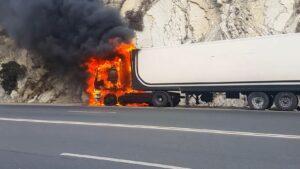


Coverage decides what a serious claim recovers. A HAZMAT truck accident often reaches insurance limits several times higher than an ordinary freight crash, because federal law demands it.
Below, we explain those limits, who writes the rules, and why the paperwork aboard the truck becomes evidence.
Why a HAZMAT Truck Accident Carries More Insurance
First, 49 CFR 387.9 sets minimum financial responsibility. General freight requires $750,000, and that figure covers most trucks on the road.
Meanwhile, hazardous cargo changes the math. Oil and most listed hazardous materials require $1,000,000, while the most dangerous commodities require $5,000,000.
That top tier is narrow but important. It covers bulk explosives in Divisions 1.1 through 1.3 and poison gas in Hazard Zone A. Certain Packing Group I poisons and highway route controlled radioactive material also qualify.
Compare $5,000,000 against $750,000. Consequently, identifying exactly what the truck carried can matter more to your recovery than any other single fact.

Speak with a Charlotte car accident lawyer and get a free consultation today.
Call (980) 246-2656Who Actually Writes These Rules
In fact, two agencies split the work. The Pipeline and Hazardous Materials Safety Administration writes the Hazardous Materials Regulations at 49 CFR Parts 100 through 180.
FMCSA handles the highway side. It enforces those rules against motor carriers, largely through 49 CFR Part 397.
The distinction matters in litigation. Each agency generates different records, and a violation of either body of rules helps establish the duty a carrier breached.
What Counts as Hazardous Material
Federal law recognizes nine hazard classes, grouped here for brevity:
- Explosives — Class 1
- Gases — Class 2
- Flammable liquids and solids — Classes 3 and 4
- Oxidizers and organic peroxides — Class 5
- Poisonous and infectious substances — Class 6
- Radioactive materials — Class 7
- Corrosives — Class 8
- Miscellaneous dangerous goods — Class 9
Placards announce the class. So the photographs from a crash scene often reveal the insurance tier before anyone requests a policy.

Why the Driver Faced Extra Scrutiny
Of course, a hazmat endorsement demands more than a CDL. Drivers pass a knowledge test, submit fingerprints, and clear a TSA security threat assessment under 49 CFR 1572, then renew roughly every five years.
Training obligations run parallel. Hazmat employees need general awareness, function-specific, safety, and security training within 90 days, with recurrent training every three years.
Those records either exist or they do not. Our article on unqualified truck drivers explains how gaps in a carrier’s files become a direct claim against the company.
Why the Paperwork Is Evidence
After all, shipping papers travel with the load. They state the proper shipping name, hazard class, identification number, and an emergency response phone number monitored throughout transport.
Those documents answer the central question. What was aboard, who shipped it, who packaged it, and which coverage tier applies.
Releases also widen the claim. When cargo escapes, contamination can injure people miles away and render property unusable for years. That reach adds defendants and damages an ordinary crash never involves.
Talk to a Peachtree City Truck Accident Lawyer
Shane Smith Law identifies the cargo, the carrier, and the coverage. Contact us for a free consultation.