

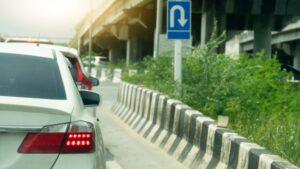
When more than one driver is at fault for an accident, comparative negligence in U-turn car accidents determines each party’s degree of fault and who will recover compensation based on the 50% bar rule.
If you were partially at fault for an accident, contact an Atlanta car accident lawyer as soon as possible to determine your rights to compensation.
How Comparative Negligence Works in Georgia
Compensation for Georgia auto accidents is determined using the comparative fault system when determining how much a party (or their associated insurance company) should pay. In other words, drivers or their insurance company will likely be held responsible for their portion of the damages following a determination of their liability.
In Georgia, a claimant’s damages are reduced by his fault percentage if they contributed 49% or less to the accident. The remaining damages are distributed among the other party or parties according to their degree of fault. However, a claimant cannot receive damages if their degree of fault is determined to be 50% or higher, in which case parties assume all financial responsibility for their own losses.
Even if your contribution to the crash was minimal, you could still lose considerable compensation. For example, if the value of your case was $100,000 and you were 15% at fault for the crash, you would only receive $85,000. This is a $15,000 loss and can impact your ability to cover damages. While comparative negligence in car accidents still allows you to recover damages, it can affect the outcome of your claim.

Speak with a Charlotte car accident lawyer and get a free consultation today.
Call (980) 246-2656What Determines Who is At Fault in a U-Turn Accident
It is illegal to make a U-turn in Georgia if it is unsafe to do so, even if a driver has a green arrow. It is also illegal to make a U-turn around curves or near a hill’s crest. Georgia drivers may be held partially responsible for an accident when they make a U-turn, even if they have a green arrow, under the following circumstances:
- Right turns: Other drivers may be making right turns. Regardless of whether there is a green arrow for the driver making the U-turn or yield signs for the automobiles making right turns, it is the U-turn driver’s obligation to make sure that a U-turn can be made safely.
- Yellow lights: Oncoming traffic may have a green light if a U-turn driver tries to make a turn on a yellow light. Drivers making U-turns must make sure they have sufficient time to complete the turn and join the traffic flow without disrupting it.
- Failure to signal: Drivers making U-turns are required to use their left turn signals.
This means that if one driver hits another driver who is making an illegal U-turn, both parties carry responsibility for the resulting collision. These accidents are investigated during the claim process to determine how much each driver contributed to the accident to make sure fault percentages are accurately assigned to the parties involved in the crash in alignment with O.C.G.A. § 51.12-33.
How Liability is Established in a Shared Fault U-turn Accident Claim in Georgia
The most recent data by the National Safety Council reports that 4.9 million drivers were injured and 42,789 were killed in motor vehicle accidents. These numbers highlight the dangers of car accidents of all kinds and the safety threat they pose to motorists. These accidents can cause extensive damage and injuries, and drivers are responsible for the harm they cause to others.
When it comes to determining fault for a U-turn accident, it’s important to understand how negligence is proven in a personal injury case. A person is liable for an accident when they were careless or reckless instead of upholding the duty of care they owed others, and caused an accident as a result. Generally, the at-fault party pays damages, but when fault is shared, damages are reduced to reflect the shared fault.
It’s important to be aware that insurance companies may try to assign blame to avoid paying you too much. That’s why having legal representation is important, so you don’t end up assuming more fault than you contributed. By gathering evidence and working with a lawyer, you can provide all the necessary information that will help protect your case and avoid a considerable loss in compensation.

Losses Your Settlement May Help Offset After a Shared-Fault Car Accident in Georgia
Since Georgia law requires that the amount you can recover be reduced if you are partially at fault, any compensation you receive will likely not cover all of your losses. However, any awarded damages you receive can still be applied to a variety of expenses and other losses you’ve sustained. Losses that can be covered by settlement funds may include:
- Medical expenses and ongoing care
- Rehabilitation services, medical equipment, and home/vehicle accommodations
- Repair costs for your vehicle and personal belongings
- Loss of wages or future earnings
- Expenses related to the funeral and burial arrangements
- Physical and emotional pain, suffering, and trauma
- Reduced enjoyment of activities that contributed to your quality of life
- Loss of consortium, companionship, or service
Consulting an Atlanta personal injury lawyer after an auto accident enhances your ability to receive a reasonable settlement because they know how to maximize your recovery. If you have been injured in a U–turn accident, you should discuss your case with an attorney right away. Lawyers protect your right to compensation so you don’t have to shoulder your financial burden in its entirety.
Navigate Comparative Negligence in Georgia With the Help of Shane Smith Law
If you or someone you know has been hurt in an auto accident involving a U-turn, meet with a Clayton County auto accident lawyer at Shane Smith Law. We can obtain evidence, protect your rights, navigate comparative negligence in U–turn cases, and optimize your case for the most favorable results possible. Schedule a free consultation with our team today to learn more about what you may recover.