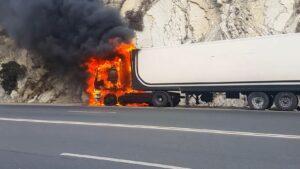


Worn pavement, missing guardrail, a curve with no warning sign. After a truck crash, these look like somebody’s fault.
Dangerous road conditions rarely produce a payment from a government, though. Sovereign immunity, design immunity, short deadlines, and damages caps each stand in the way. Worse, a trucking company often raises the road for a reason that has nothing to do with helping you.
Below, we explain what Georgia actually permits. We also cover why the road argument usually belongs to the defense.
Why Dangerous Road Conditions Rarely Produce a Government Payout
Start with the structure. Georgia governments enjoy immunity unless a statute waives it, and each level of government operates under a different statute.
The state waived some immunity through the Georgia Tort Claims Act. Cities and counties sit outside that Act entirely, under rules of their own.
Exceptions then swallow much of what remains. One exception in particular ends most road cases before they begin.

Speak with a Charlotte car accident lawyer and get a free consultation today.
Call (980) 246-2656The Immunity That Defeats Most Design Claims
O.C.G.A. § 50-21-24(10) protects design decisions. Immunity survives for “the plan or design for construction of or improvement to highways, roads, streets, bridges, or other public works.”
A qualifier applies. Someone must have prepared the plan “in substantial compliance with generally accepted engineering or design standards in effect at the time of preparation.”
Read the timing clause closely. The standard dates from when the plan was drawn, not from when the crash happened.
Georgia courts extended that further. One 2017 decision, Georgia Department of Transportation v. Balamo, 343 Ga. App. 169, held design immunity also covers a failure to upgrade an older road. Allowing that claim, the court reasoned, would “effectively eliminate the protection” the statute provides.
Three items from the typical list die right there. Narrow lanes, inadequate shoulders, and missing barriers are design decisions.
Three Governments, Three Sets of Rules
Interstates and state routes belong to GDOT. County roads and city streets answer to different entities, and the maintaining authority decides both the defendant and the deadline.
Picking wrong is fatal rather than inconvenient. A notice served on the wrong government does not preserve anything.
County road maps help identify the right one. Georgia requires each county to file a road map open to public inspection.

Why the Notice Deadline Can Be Six Months
Deadlines here are far shorter than the two-year injury period. Under § 50-21-26, a claim against the state requires written notice within 12 months of discovering the loss.
Two recipients must get it. Notice goes to the Department of Administrative Services and to the state entity involved.
Cities run on half that clock. Section 36-33-5 sets a six-month notice requirement, served on the mayor or the chair of the council or commission. Subsection (e) also makes the notice state a specific dollar amount.
Counties take 12 months under § 36-11-1. So the same crash can carry three different deadlines depending on who maintained the pavement.
Compliance is not a technicality. The state’s notice requirement is jurisdictional, which means a court cannot excuse a late one.
What a State Claim Recovers, and What It Cannot
Caps arrive next. Section 50-21-29 limits recovery to $1,000,000 per person and $3,000,000 per occurrence.
Multiple agencies change nothing. The cap applies “regardless of the number of state government entities involved,” and a jury never learns the limit exists.
Two categories vanish entirely. Section 50-21-30 bars punitive damages and prejudgment interest against the state.
Employees also leave the case. Under § 50-21-25, you cannot name the individual state worker, because the entity gets substituted.
Why Cities Require Actual Notice
Municipal road claims carry their own obstacle. Section 32-4-93(a) excuses a city that “has had no actual notice” of a defect. The same provision excuses one where a defect has not lasted long enough for notice to be inferred.
Proving notice becomes the case. Prior complaints, work orders, and inspection records decide it.
One subsection catches people out. Subsection (b) generally frees a city from responsibility for state highways and county roads inside its limits. An exception applies where the city built them or agreed to maintain them.
Recent authority narrowed things further. City of Milton v. Chang (Ga. 2026) held that § 32-4-93(a) is not itself an immunity waiver. That decision also limits a city’s ministerial duty to the lanes of travel, not every area a vehicle might enter.
Why Counties Are Harder Still
County immunity runs broader than municipal immunity. Section 36-1-4 says flatly that “a county is not liable to suit for any cause of action unless made so by statute.”
A duty exists without a remedy. Section 32-4-41(1) requires a county to “maintain an adequate county road system.” That statute waives no immunity, and the same section writes express non-liability into its own text.
Do not confuse this with vehicle claims. Section 36-92-2 waives local immunity for negligent use of a motor vehicle. A road defect is a different thing.
Why the Trucking Company Wants the Road to Be at Fault
Here the page’s premise inverts. A dangerous road condition more often helps the trucking company than the injured person.
Georgia lets juries apportion fault to parties nobody can sue. Walker v. Tensor Machinery, 297 Ga. 600 (2015), permits consideration of a person’s fault “notwithstanding that he may have a meritorious affirmative defense or claim of immunity.”
Section 51-12-33 supplies the mechanism. Subsection (c) counts the fault of anyone who contributed, “regardless of whether the person or entity was, or could have been, named as a party.” A defendant may then give nonparty notice under (d)(1), at least 120 days before trial.
Now follow the money. Subsection (b) makes apportioned damages several rather than joint. Any percentage a jury assigns to an immune road authority therefore disappears from your recovery.
Nobody picks it up. Subsection (f)(2) creates no liability for the nonparty, so that share goes unpaid.
When a Contractor Is the Right Defendant
Construction zones follow different rules. Section 50-21-22(7) excludes independent contractors from the definition of a state officer or employee.
GDOT may hand off the work. In Georgia Department of Transportation v. Wyche, 332 Ga. App. 596 (2015), the court held GDOT could delegate construction-zone safety and remain immune for a contractor’s negligence.
That makes the contractor a real target. No cap applies, punitive damages stay available, and no ante litem notice governs.
Timing limits it, though. Georgia’s acceptance doctrine generally ends a contractor’s exposure once the government completes and accepts the work.
Why This Still Matters to Your Case
None of this makes the road irrelevant. Identifying a genuine maintenance failure, with actual notice proven, occasionally produces a second source of recovery.
Preparation matters more often than the claim. Knowing what the trucking company will argue, and being ready to answer it, protects the recovery you already have.
Talk to a Fayette County Truck Accident Lawyer
Shane Smith Law determines which entity maintained the road and which deadline applies. We also assess whether the road argument helps your claim or threatens it. Call (980) 246-2656 for a free consultation.