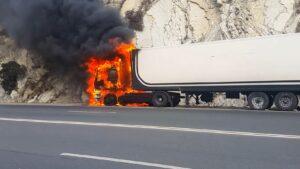
A truck crash can involve the driver, a maintenance shop, a loading crew, a manufacturer, and the trucking company itself. Each party has a reason to blame someone else. Trucking companies push hardest of all, because they usually carry the largest insurance policies. This article explains how carriers try to limit trucking company liability and why federal rules often stop them.
Why Trucking Company Liability Matters
The driver rarely has enough insurance to cover a serious crash. By contrast, federal rules require most interstate carriers to carry at least $750,000 in liability coverage. Many carry much more.
That gap explains the fight. If the carrier escapes responsibility, the injured person may recover only a fraction of the losses. For that reason, the question of who controls the truck often decides the value of the case.

Speak with a Charlotte car accident lawyer and get a free consultation today.
Call (980) 246-2656Tactic One: Calling the Driver an Independent Contractor
Many carriers label drivers as independent contractors instead of employees. Normally, a company does not answer for an independent contractor’s mistakes. Carriers hope that label will keep them out of the case.
Federal law often blunts that strategy. The federal motor carrier safety statute defines an “employee” to include an independent contractor while operating a commercial motor vehicle. In other words, a contract label does not erase the driver’s safety duties to the public.
The label also does not end the analysis under Georgia law. Courts look at who actually controlled the work, the truck, and the route. Dispatch records, pay records, and the lease itself often reveal that control.
Tactic Two: Leasing Trucks Instead of Owning Them
Some carriers lease trucks from owner-operators rather than buying them. The carrier may then argue that the truck’s owner bears responsibility for the crash. In particular, carriers sometimes claim the owner handled all maintenance.
Federal leasing rules cut against that argument. Under 49 CFR 376.12(c)(1), the lease must give the carrier exclusive possession, control, and use of the truck. The carrier must also assume complete responsibility for operating it during the lease.
Georgia courts have applied that rule to hold carriers responsible for leased trucks. Furthermore, federal maintenance rules generally reach vehicles under a carrier’s control, not just vehicles it owns. A lease, therefore, rarely lets a carrier walk away from a crash its truck caused.

Tactic Three: Blaming Other Companies
Large crashes often involve several businesses. A shipper may have loaded the trailer. Perhaps a repair shop worked on the brakes. Meanwhile, a manufacturer may have built a defective part.
Carriers use those connections to spread the blame. Under Georgia’s apportionment law, a jury divides fault among everyone responsible, including some parties who are not in the lawsuit. Each percentage assigned elsewhere can shrink what the carrier pays.
That strategy works best when nobody challenges it. A careful investigation can show which failures truly caused the crash. In many cases, that evidence points back to the carrier’s own choices.
Tactic Four: Controlling the Evidence
Trucking companies hold most of the evidence after a crash. Electronic logs, engine data, maintenance files, and driver records all sit in the carrier’s hands. Federal rules let carriers discard some of those records after six months.
Many carriers also send rapid-response teams to the scene within hours. Those teams protect the company, not the injured person. Consequently, the carrier’s version of events can take shape long before a victim leaves the hospital.
A preservation letter from a lawyer can stop routine destruction of key records. Without one, critical proof may disappear long before any lawsuit.
What About Brokers and Shippers?
Many loads move through freight brokers who arrange the trip but never touch the truck. Brokers often argue they bear no responsibility for a carrier’s crash. Courts across the country disagree about when a broker can face a negligent selection claim.
Shippers present a different question. A shipper that loads a sealed trailer may answer for hidden loading defects. However, the carrier generally keeps the main duty for safe loading when problems are visible. Sorting out these roles requires the shipping documents, which the companies rarely share without a fight.
When the Carrier Answers for Its Own Choices
Trucking company liability does not depend only on the driver’s mistakes. A carrier can also face claims for its own decisions. For example, it may have hired a driver with a poor safety record or skipped required inspections.
Other company failures matter too. A carrier might pressure drivers to break hours-of-service limits or ignore known mechanical problems. Each of those choices can make the company directly responsible.
Georgia law also allows a jury to consider these claims alongside the driver’s negligence. Since a 2020 Georgia Supreme Court decision, carriers can no longer block negligent hiring claims simply by admitting the driver worked for them.
How Fayette County Crashes Fit the Pattern
Trucks move through Fayette County on Highway 74, Highway 54, and Highway 85 every day. Many serve warehouses, construction sites, and retail stores across the south metro area. Some belong to national carriers, while others belong to small owner-operators under lease.
That mix makes the ownership question common here. A single local crash may involve a leased tractor, a borrowed trailer, and a load arranged by a broker. Therefore, the first task after a serious crash is often mapping who controlled each piece.
Why Georgia’s 2024 Change Raises the Stakes
Georgia once let injured people sue a trucking company’s insurer directly in many cases. In 2024, the legislature narrowed that rule sharply. For crashes on or after , direct claims against the insurer usually require special circumstances, such as an insolvent carrier.
As a result, identifying the right company matters more than ever. The claim must reach the carrier itself, not just its insurer. Getting that wrong can delay a case or cost key coverage.
Why Federal Rules Help Injured People
The trucking industry operates under detailed federal safety rules. These rules cover driver qualifications, hours of service, inspections, and cargo securement. Georgia adopts many of them through state law.
When a carrier breaks one of these rules, that violation can support a negligence claim. However, the violation must connect to the crash or the injuries. A lawyer can match the evidence to the rules that matter most.
What a Claim Against a Trucking Company Can Cover
Truck crashes often cause life-changing injuries. A claim may include hospital care, surgery, rehabilitation, and future medical needs. It can also cover lost income and reduced ability to work.
Georgia law also allows recovery for pain and suffering. When a crash takes a life, the family may bring a wrongful death claim. Additionally, a carrier that knowingly kept a dangerous driver on the road may face punitive damages in some cases.
Each of these damages depends on reaching the right defendant. A recovery limited to the driver’s policy can leave a family with years of unpaid bills.
Why You Need a Lawyer Against a Trucking Company
Trucking companies prepare for crashes long before they happen. Their insurers and defense lawyers know every tactic described above. Without equal preparation, an injured person may accept far less than the claim’s real value.
A lawyer can trace the lease, the contracts, and the chain of control. Your attorney can also identify every insurance policy and preserve evidence before it disappears. Georgia generally allows two years to file an injury lawsuit, but key records can vanish in weeks.
Contact a Fayette County Truck Accident Lawyer for a Free Consultation
If a truck crash in Fayette County left you injured, Shane Smith Law can review your case for free. We will explain who may be responsible and which deadlines apply. You pay no attorney fee unless we recover money for you.
Call 980-246-2656 today to talk with our team about your options.