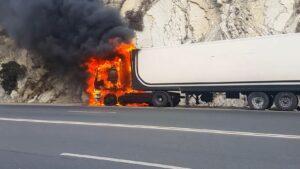


Few accident scenes are more chaotic — or more legally complicated — than a multi-vehicle pileup involving a semi-truck. When a fully loaded tractor-trailer is involved in a chain-reaction collision on a congested Charlotte highway, the result is often a tangle of multiple vehicles, multiple drivers, and multiple insurance companies, all pointing fingers in different directions. For victims trying to recover compensation, figuring out who’s responsible can feel like an impossible task — but it’s rarely as impossible as it seems, with the right investigation.
Why Semi-Trucks Are Often at the Center of Pileups
Tractor-trailers play an outsized role in multi-vehicle pileups for a few key reasons:
Stopping distance. A fully loaded semi-truck requires significantly more distance to stop than a passenger vehicle is often twice as much or more, depending on speed and road conditions. When traffic suddenly slows or stops on a congested highway, a truck that fails to leave adequate following distance may be unable to stop in time, triggering a rear-end collision that cascades into the vehicles ahead.
Size and momentum. Even at moderate speeds, the sheer mass of a tractor-trailer can push multiple vehicles together on impact, turning what might have been a two-car accident into a chain-reaction pileup involving five, ten, or more vehicles.
Jackknifing and loss of control. A truck that jackknifes — where the trailer swings out from the cab, often due to sudden braking or road conditions — can block multiple lanes of traffic at once, creating a secondary hazard for vehicles that don’t have time to react.
Reduced visibility conditions. Fog, heavy rain, or sudden traffic backups on interstates like I-85 and I-485 can create situations where a truck driver has little warning before encountering stopped traffic — a common trigger for large-scale pileups.
Why Fault Is So Complicated in a Pileup
Unlike a simple two-vehicle crash, a multi-vehicle pileup usually involves several distinct collisions happening in rapid succession. Untangling what happened requires answering questions like:
- Which vehicle initiated the chain reaction?
- Did the truck driver fail to maintain a safe following distance, or were they reacting to another driver’s sudden stop?
- Were multiple drivers following too closely, compounding the severity of the crash?
- Did weather, road conditions, or a prior unrelated incident play a role?
- Was the truck’s cargo properly secured, or did shifting freight contribute to a loss of control?
In many cases, more than one driver bears some degree of fault — which becomes especially important in North Carolina.
North Carolina’s Contributory Negligence Rule in Multi-Vehicle Crashes

Speak with a Charlotte car accident lawyer and get a free consultation today.
Call (980) 294-4931North Carolina follows a strict contributory negligence rule: if a victim is found even 1% at fault for a crash, they can be completely barred from recovering compensation — regardless of how much more at fault another party may have been. In a chaotic pileup involving multiple vehicles, insurance companies often look for any opportunity to shift even partial blame onto an injured victim to avoid paying a claim.
This makes a thorough, independent investigation especially critical in pileup cases. Establishing a clear, evidence-based sequence of events — showing precisely how the crash unfolded and who caused the initial impact — is often the key to protecting a victim’s right to compensation.
How Fault Gets Established in a Complex Pileup
Reconstructing a multi-vehicle pileup involving a semi-truck typically requires:
- Police accident reports, which document initial officer observations and often include a preliminary sequence of events
- Electronic logging device (ELD) and black box data from the truck, showing speed, braking, and driver hours leading up to the crash
- Traffic and dashcam footage, if available, from the truck, other vehicles, or nearby businesses
- Witness statements, which are especially valuable in pileups given how much can happen in just a few seconds
- Accident reconstruction experts, who can analyze physical evidence — skid marks, vehicle damage patterns, and final resting positions — to determine the sequence of impacts
Because so many vehicles and parties are typically involved, this investigation often requires more time and more resources than a standard two-vehicle crash.
Multiple Insurance Companies, Multiple Negotiations
A multi-vehicle pileup frequently means dealing with several insurance companies at once each representing a different driver, and each motivated to minimize its own client’s share of liability. Without a clear, well-documented account of how the crash occurred, victims can get caught in a dispute between insurers, each pointing to another party as primarily responsible, while the victim’s claim stalls in the middle.
What to Do If You’re Involved in a Pileup With a Semi-Truck
- Prioritize medical attention, even for injuries that seem minor at first
- Document the scene as thoroughly as possible, including vehicle positions, damage, and road conditions
- Avoid discussing fault or giving recorded statements to any insurance company before speaking with an attorney
- Contact an attorney quickly, so evidence like ELD and black box data can be preserved before it’s lost
The “Phantom Fault” Problem

One of the most frustrating dynamics in a multi-vehicle pileup is what’s sometimes informally called the “phantom fault” problem: each driver’s insurance company points to another vehicle as the true cause of the crash, and no one wants to accept responsibility. Without an independent investigation, a victim caught in the middle of this dispute can find their claim stalled indefinitely, as insurers wait each other out. Breaking through this dynamic typically requires an attorney willing to conduct an independent investigation — rather than relying solely on the initial police report or the insurance companies’ own competing narratives — and, when necessary, to pursue litigation to force a resolution.
How Comparative Fault Among Multiple Drivers Is Handled
When a pileup involves several at-fault parties, North Carolina’s contributory negligence rule creates a unique dynamic. A victim’s claim against one driver isn’t automatically barred just because another driver also bears fault — but if the victim’s own conduct is found to have contributed even slightly to the crash, that alone can bar recovery from every party involved. This makes it especially important to build a case that clearly and convincingly establishes the victim played no role in causing the accident, particularly when multiple vehicles and drivers are part of the same chaotic event.
Why Timing Matters Even More in Pileup Cases
In a standard two-vehicle accident, evidence typically comes from two drivers, their vehicles, and perhaps a handful of witnesses. In a multi-vehicle pileup, the volume of potential evidence — additional vehicles, additional drivers, additional witnesses, and often footage from nearby traffic or business cameras — is much greater, but it’s also more likely to disappear quickly. Witnesses who saw only part of the crash may be difficult to track down once they’ve left the scene. Nearby security camera footage is frequently overwritten within days. The truck’s own electronic data faces the same short preservation window as in any other truck accident case. Because so much more evidence needs to be gathered and preserved in a pileup, prompt legal action is even more critical than in a typical crash.
Let Us Untangle the Evidence for You
Multi-vehicle pileups involving semi-trucks are some of the most complex cases in personal injury law — but with a thorough investigation, the truth of what happened can almost always be established. Shane Smith Law has the resources and experience to investigate complex, multi-party truck accidents and fight for the compensation Charlotte-area victims deserve. Contact us today for a free consultation.